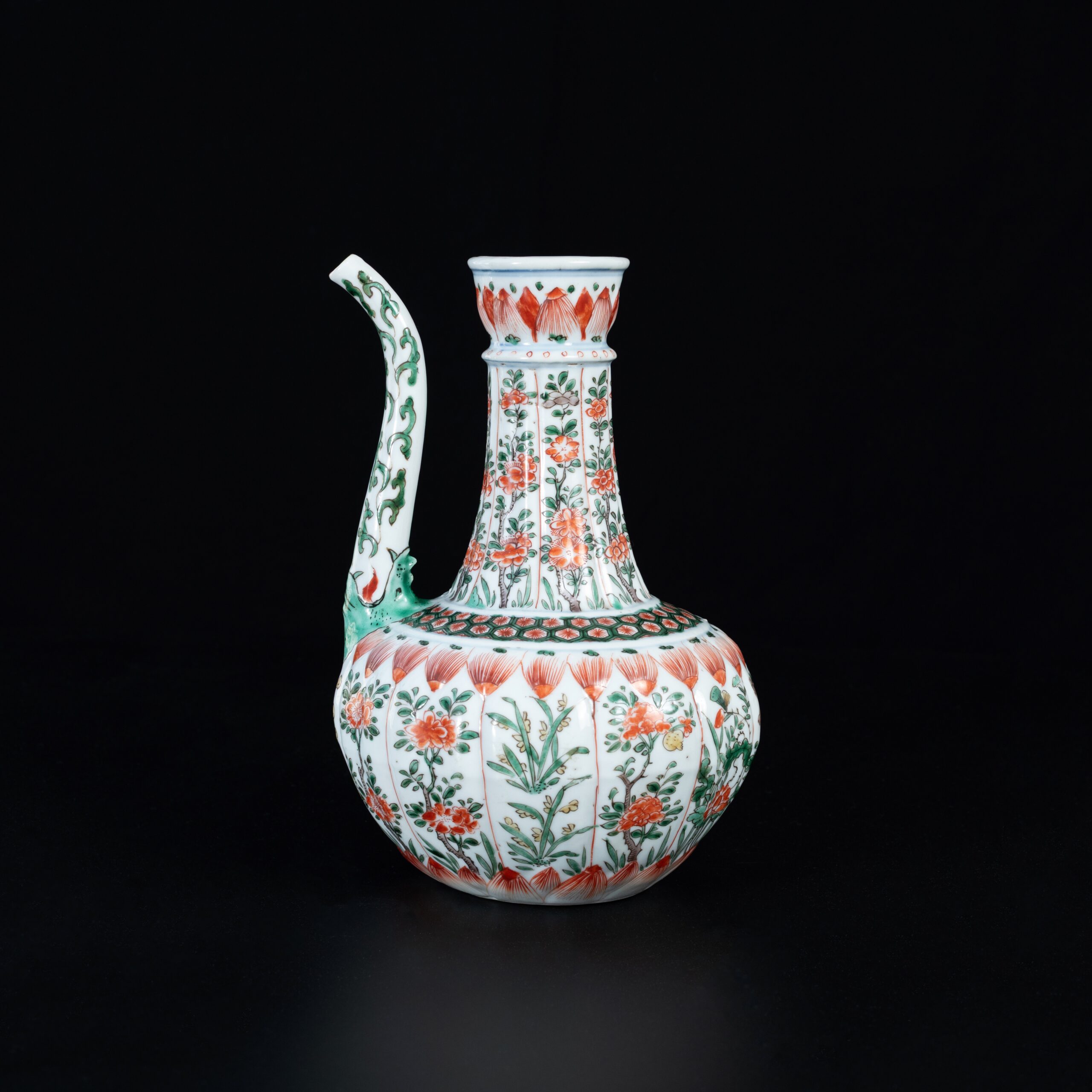
• Kangxi Period (1661-1722)
• H : 20cm
• Inv. GD288
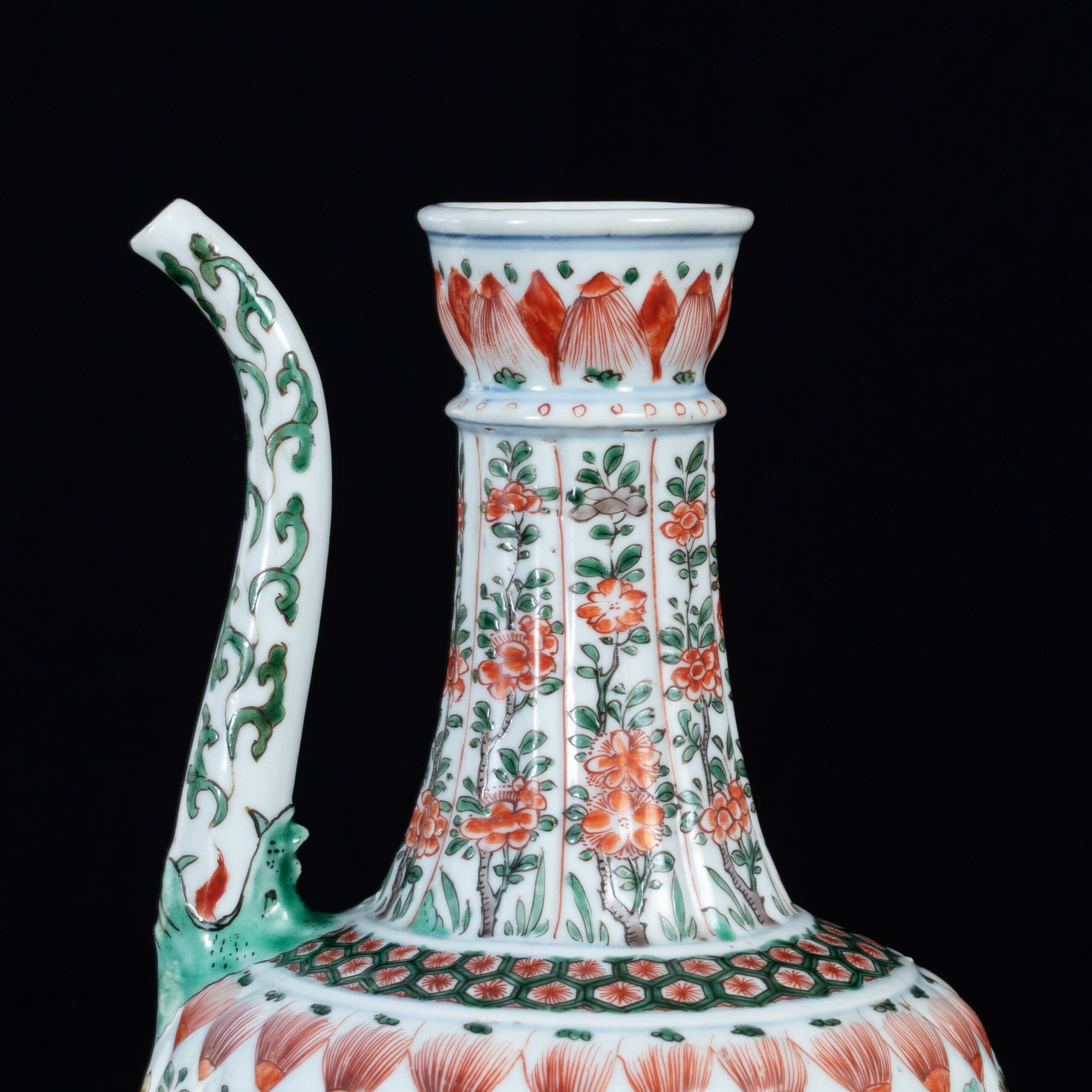
A large Famille Verte ewer.
ADDITIONAL INFORMATION :
We frequently encounter a very similar model described as an “ewer”, decorated either in Famille Verte or in blue and white. For example, the Famille Verte version is illustrated by Christian Jörg in Famille Verte Chinese Porcelain in Green Enamels (cited above), that example notably has a spout that ends lower than the model exhibited here.
This form is probably inspired by Middle Eastern shapes. During the Ming dynasty, we can already observe kendis with a similar silhouette — in particular in the book Kraak Porcelain: A Moment in the History of Trade by Maura Rinaldi (1989), Shape I.3: kendis, pp.177‑179. A specific kendi close to the shape of our model is illustrated on pl.229, p.179, showing a chimera’s mouth at the junction of the spout and the body. Another example, on pl.228 of the same page, shows a long spout that terminates at the same level as the collar opening.
The principal specificity of the present piece is the way its spout terminates — at the same height as the opening of the neck opening. We have not yet found identical pieces, but for comparison, there is a model of the same type in blue and white whose spout ends in exactly the same way (references given above). What is remarkable in both models — whether in Famille Verte or blue and white — is the presence of a chimera with its open mouth at the junction between body and spout, as well as the symmetrical floral decoration in reserved panels.
In the case of the blue and white variant, wich identical to ours, it has even been argued that this piece may originally have been a large sprinkler, rather than a simple ewer.
BIBLIOGRAPHY :
For an identical blue and white model, see:
– Porcelaines chinoises dans un manoir normand, Une Histoire des “Bleu et Blanc”, Alain Saint‑Loubert‑Bié, 2010, p.98 (Manoir des Évêques).
For a similar Famille verte form, see:
– Famille Verte Chinese Porcelain in Green Enamels, Christiaan J.A. Jörg, 2011, pp.150–151, fig.147.
PROVENANCE :
– Private french collection
AVAILABLE