• Qianlong Period (1736-1795)
• D : 21,6cm / 21,8cm
• Inv. GD415
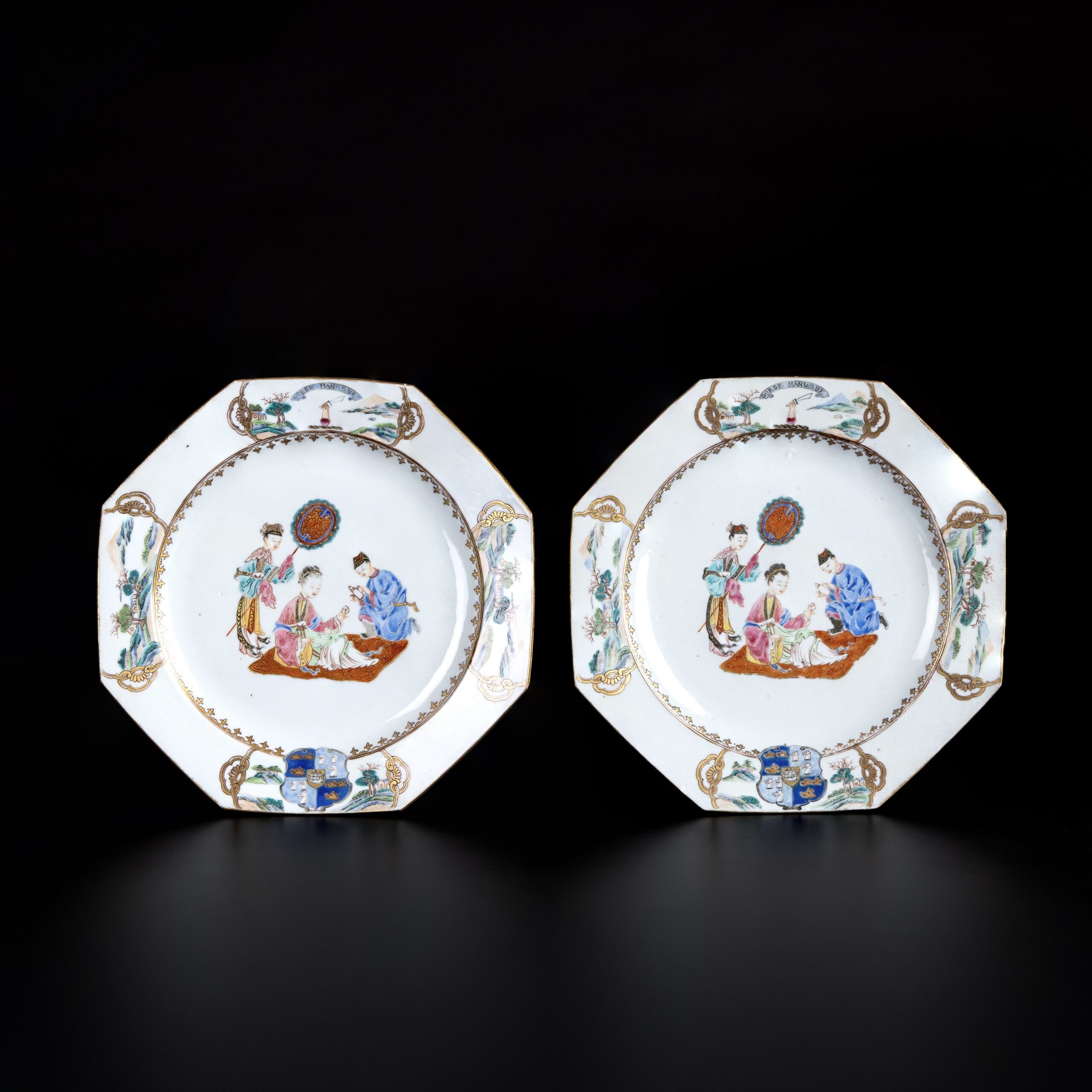
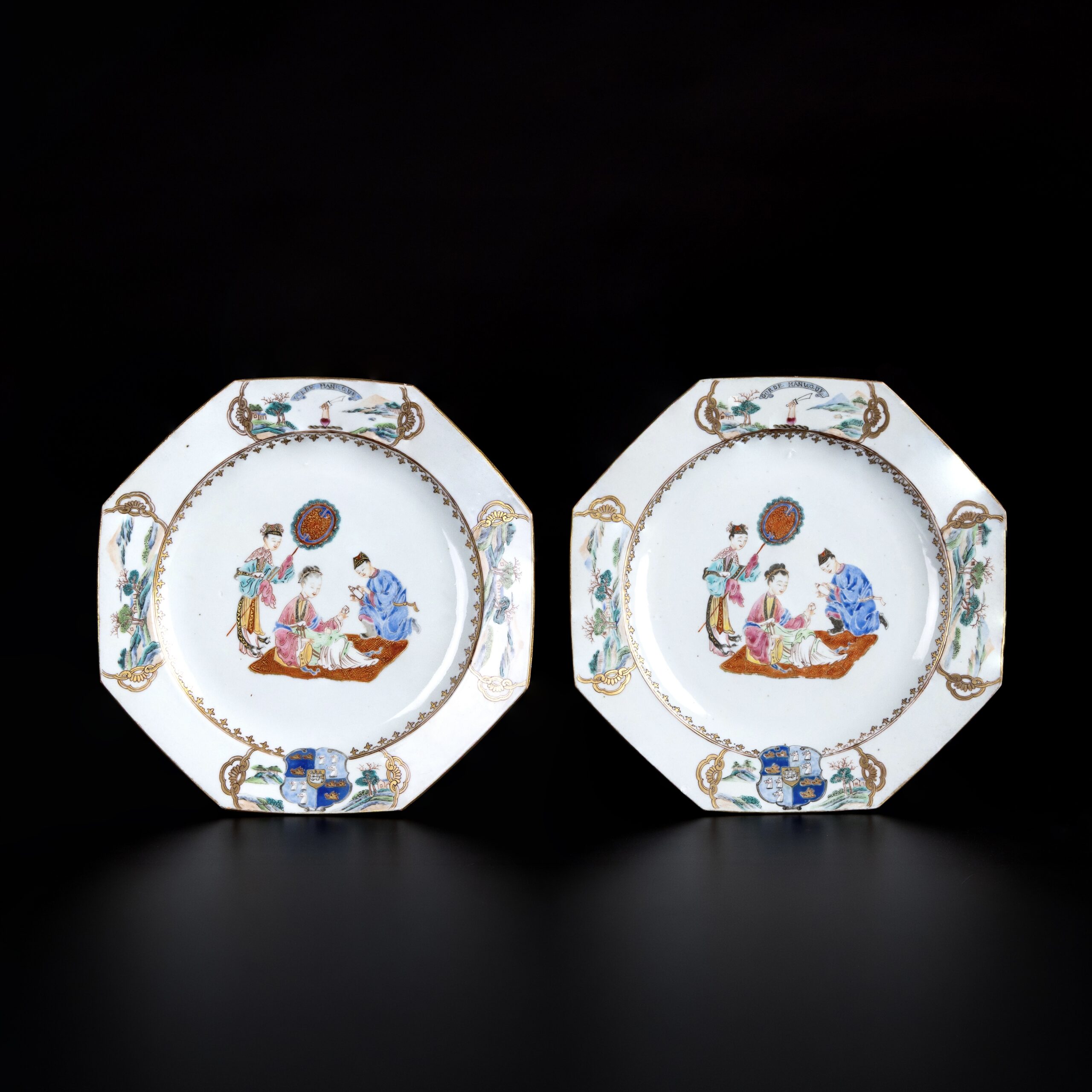
A pair of octagonal porcelain plates decorated in famille rose enamels with the arms of Gordon quartering Forbes, with a central tea scene.
ADDITIONAL INFORMATION :
This pair of plates was intended for the English market, and the arms represented are those of the Gordon/Forbes family. Another service, commissioned for the English market, exists with the same decoration and bearing the arms of Powell and Cleland; it is also illustrated in Chinese Armorial Porcelain, David S. Howard, 1974, vol. 1, p. 314, fig. J2.
The arms belong to a branch of the Gordon of Invergordon family, an old landed family from the north of Scotland, raised to the dignity of baronet in 1705. The shield is quartered: the first and fourth quarters bear the arms of Gordon, Azure, three boars’ heads couped Or; the second and third those of Forbes, Azure, three bears’ heads couped Argent, muzzled Gules (Chinese Armorial Porcelain, D. S. Howard, vol. I, 1974, p. 313, no. J1). At the centre is an escutcheon of pretence Or charged with a ship under sail.
The crest represents a dexter hand issuing from a heart and holding a dagger, accompanied by the motto Corde Manuque, meaning ‘ with heart and hand’. This motto is recorded for the Gordon of Invergordon family, notably in documentation relating to Sir William Gordon of Invergordon in the 18th century. (The Families of Gordon of Invergordon, John Malcolm Bulloch, , 1906.)
The history of the Gordon of Invergordon family nevertheless presents a particularly interesting commercial dimension. Sir Adam Gordon of Dalpholly, an ancestor of the branch, made a significant part of his fortune through trade. He notably held a share in the merchant ship Bon Accord, as well as a substantial portfolio of shares in the Company of Scotland Trading to Africa and the Indies. These elements are documented in the genealogical study devoted to the Gordon of Invergordon families (The Families of Gordon of Invergordon, John Malcolm Bulloch, 1906). This commercial tradition provides a possible context for understanding the presence of a ship on the escutcheon of pretence. More particularly, the archives of the East India Company attest to the existence of a Captain. John Gordon, a Scotsman, commander of the Montagu, an East Indiaman engaged in trade with China. He appears as commander during the voyage to China of 1719–1720, and again during a further voyage to Canton in 1722–1723. The Canton archives directly mention his activities and his dealings with the Company authorities. ( The European Canton Trade, 1723: Competition and Cooperation, Paul A. Van Dyke & Jan Parmentier, 2016).
This convergence is worthy of note, without, however, allowing the commissioner of the service to be identified.
BIBLIOGRAPHY :
For an identical example, see:
– Chinese Export Porcelain, Elinor Gordon, 1977, p. 14.
– Victoria and Albert Museum, London, no. C.332-1931.
– Chinese Armorial Porcelain, David S. Howard, 1974, vol. 1, p. 313, fig. J1.
– Sotheby’s, Chinese Export Porcelain From The Private Collection of Elinor Gordon, 23 January 2010, lot 145.
– Royal Museums of Art and History, Brussels.
For a dish, see:
– Chinese Export Porcelain in Private Brazilian Collections, Jorge Getulio Veiga.
PROVENANCE :
– Private french collection
AVAILABLE