• Late Ming Dynasty (1368–1644) / Early Kangxi Period (1661–1722)
• H / L : 27cm / 23cm
• Inv. GD334
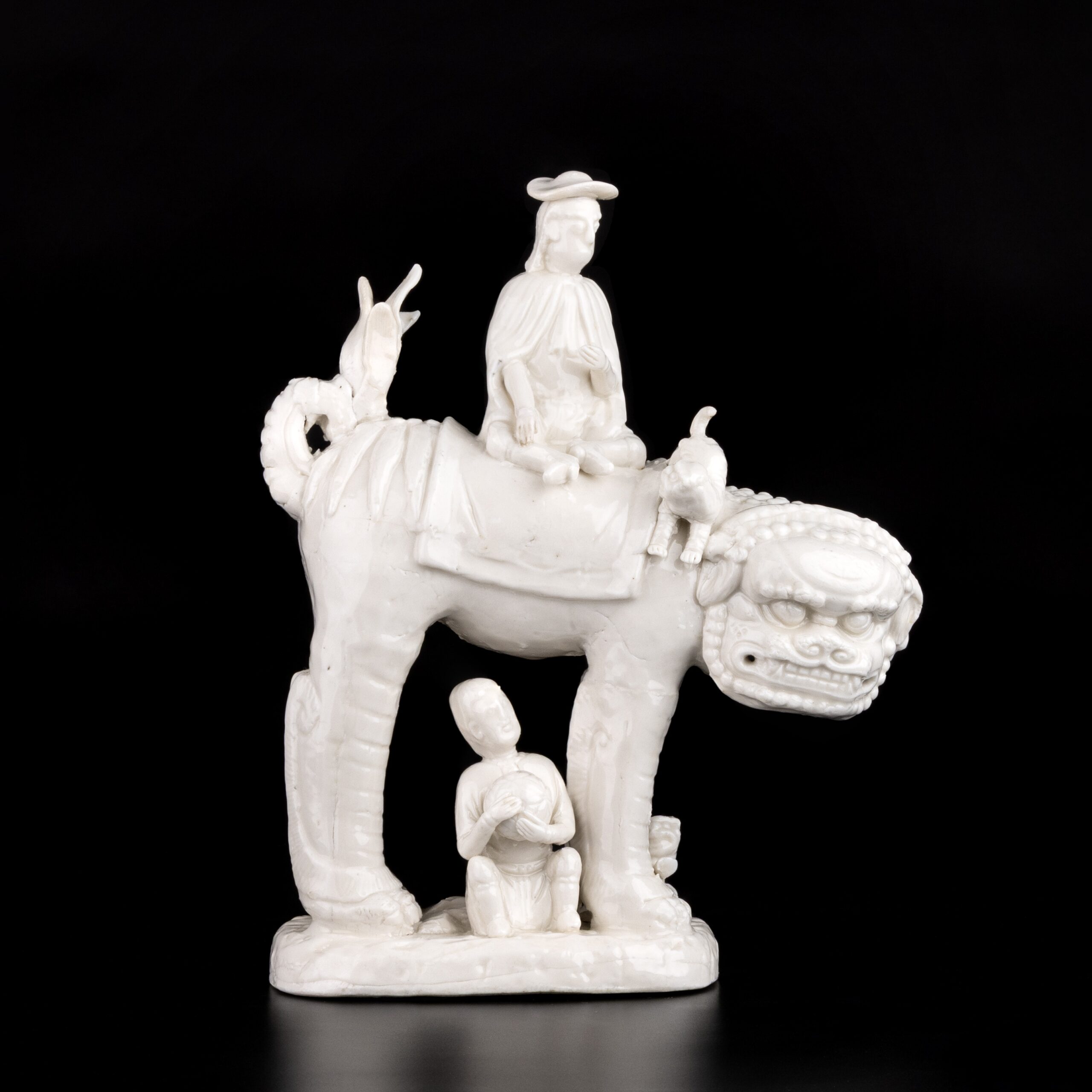
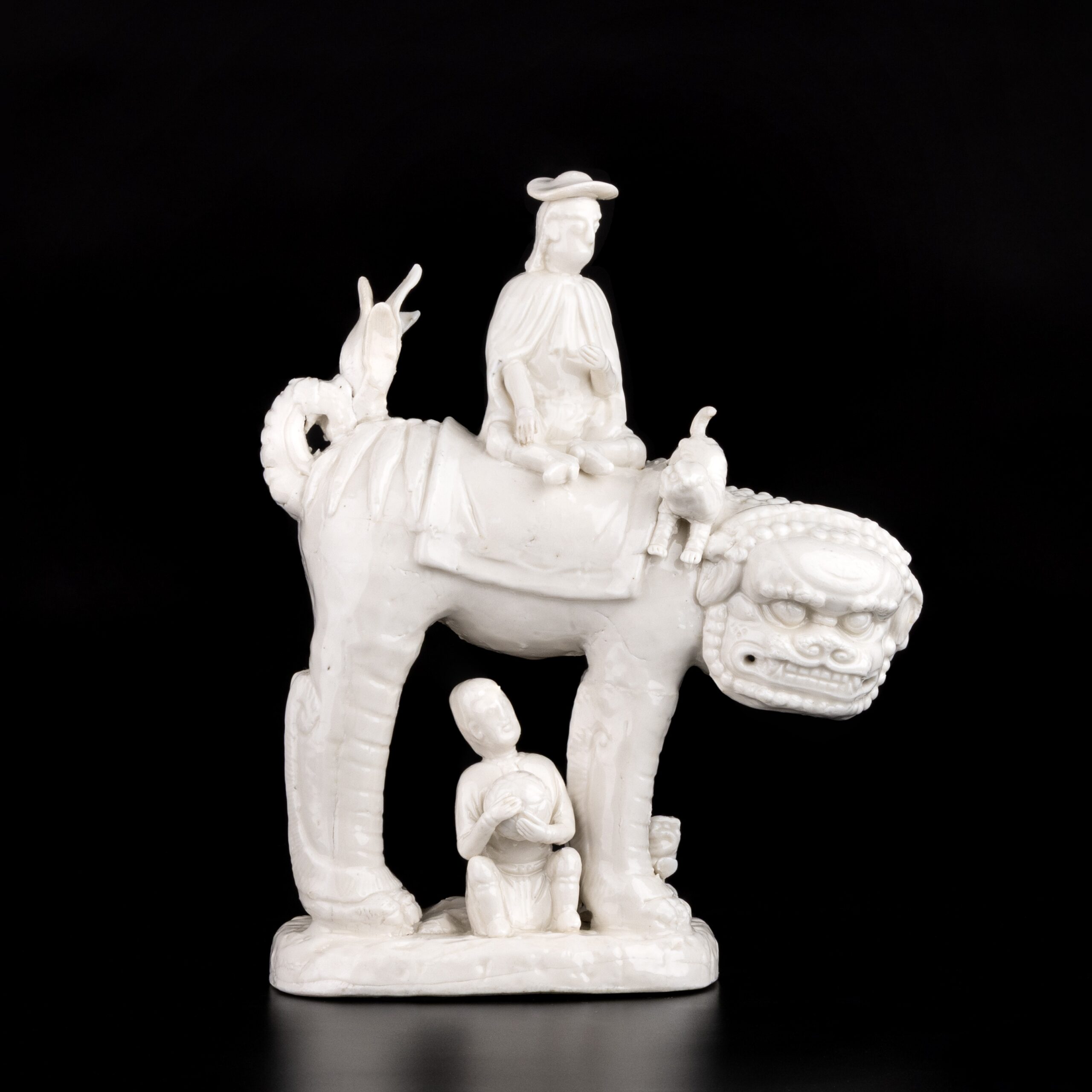
A large Dehua Blanc de Chine porcelain group depicting a European on a large Buddhist lion. Another lion stands before the European, while a child plays among the animal’s legs. The group is covered with a fine cream-coloured glaze.
ADDITIONAL INFORMATION :
This group is characteristic of Dehua production of the late 17th century, both in its style and in the tone of its porcelain body, a white tending towards ivory that is typical of Blanc de Chine. The scene depicts a horseman seated on a Buddhist lion, a mythical creature derived from Asian protective iconography. The lion belongs to the repertoire of symbolic animals intended to evoke power, protection and spiritual authority.
The horseman, for his part, is represented as a European, identifiable by his costume, posture and hat. This type of representation recurs in Dehua wares intended for export.
It is generally accepted that these Europeans most often represent Dutchmen, owing to the importance of trade between the Dutch Republic and China in the late 17th century. This hypothesis is widely repeated in various publications, although it cannot be systematically confirmed. Comparable groups depicting Europeans on horseback or mounted on fantastic creatures are known in several collections and publications (Blanc de Chine, P. J. Donnelly, 1969, p. 116, figs. A and C; Marchant, Blanc de Chine Exhibition, 2006, fig. 46, p. 74; Marchant, Blanc de Chine Exhibition, 2014, fig. 48, p. 78). Although stylistically varied, these works share several recurring features: relatively large dimensions for Dehua production, and a recurring desire to depict a Western figure within an exotic and symbolic setting.
This group thus forms part of a broader corpus of works bearing witness to the artistic, cultural and commercial exchanges between East and West.
Donnelly further mentions the possibility that some of these groups may have been conceived as pairs. He notes the existence of compositions facing in opposite directions, forming symmetrical ensembles, although true pairs are rare. One example was formerly in the collection of the Van Cortland family in New York, before being dispersed and entering the Ionides Collection (Blanc de Chine, P. J. Donnelly, 1969, p. 193).
BIBLIOGRAPHY :
For a comparable group, see:
– Blanc de Chine, P. J. Donnelly, 1969, p. 119, fig. A.
– Sotheby’s, New York, Important Chinese Art, 2016, lot 301.
– The Ringling Museum, USA, no. SN11122.179.
For a group depicting a European on an elephant, see:
– The Ringling Museum, USA, no. SN11122.302.
PROVENANCE :
– European private collection
AVAILABLE