• Kangxi Period (1661-1722)
• H / L : 7,7cm / 11,8cm
• Inv. GD489
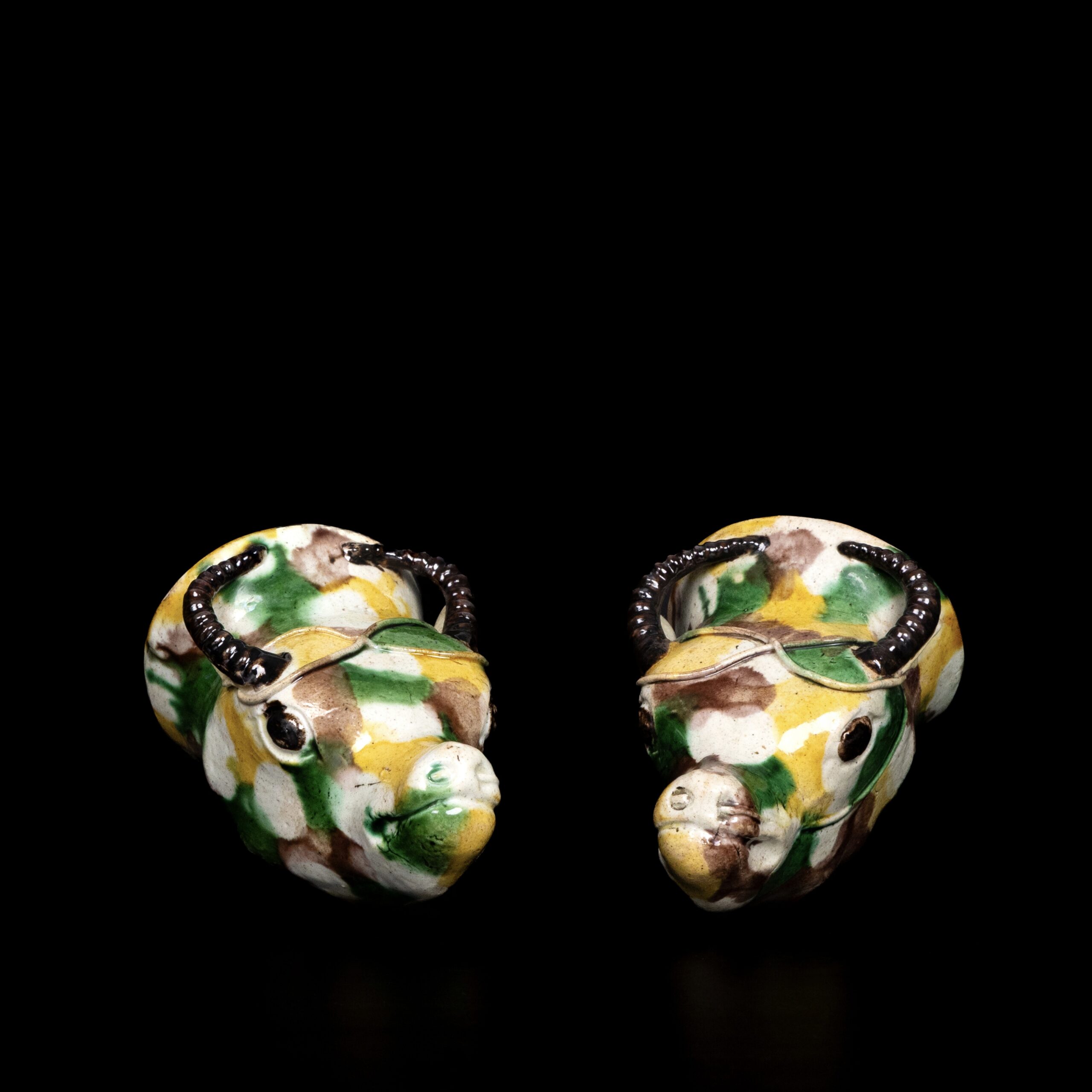
Two sancai-glazed buffalo-form rhytons.
ADDITIONAL INFORMATION :
This form, known as a rhyton, is a zoomorphic wine or libation cup. The vessel is formed by the buffalo’s head. This form has existed at least since the Tang dynasty. Later examples of this form are also known, notably from the Yongzheng (1723–1735) and Qianlong (1736–1795) periods. By way of example, a rhyton from Robert McPherson Antiques in London, formerly with Bluett & Sons, was sold at Bonhams on 15 May 2026, in the sale A Life in Ceramics: The Peter and Mary White Collection of Chinese Art, Part III, lot 274.
William R. Sargent, in The Copeland Collection: Chinese and Japanese Ceramic Figures, 1991, fig. 32, p. 83, explains that these wine cups were not necessarily intended for export to Europe, but may possibly have been collected by Europeans.
There are numerous interpretations of this form. One may, for example, observe several imperial jade rhytons made for the Qianlong Emperor, as well as examples in their more archaic form.
BIBLIOGRAPHY :
For a similar model, see:
– Collecting Chinese Export Porcelain, Elinor Gordon, 1977, p. 93, no. 80.
– Christie’s Pictorial History of Chinese Ceramics, Anthony du Boulay, 1984, no. 13, p. 297.
For a turquoise-glazed model, see:
– The Copeland Collection: Chinese and Japanese Ceramic Figures, W. Sargent, 1991, p. 85, fig. 32.
For an identical rhyton formerly with R. M. Chait Galleries, New York, see:
– Sotheby’s, New York, Important Americana, 24 January 2014, lot 32.
This pair was exhibited at the Museum für Ostasiatische Kunst, Cologne: Kostbare Chinesische Keramik, 1965, cat. no. 151, pl. 27.
PROVENANCE :
– Edward Rathbone Bacon (1846-1915)
– Christie’s, London, 8th June 1987, lot 80
– Marvin Davidson Collection
– Marchant Asian Art, London
– European private collection
AVAILABLE