• Late 18th / Early 19th
• H / D : 6,8cm / 12,4cm
• Inv. GD291
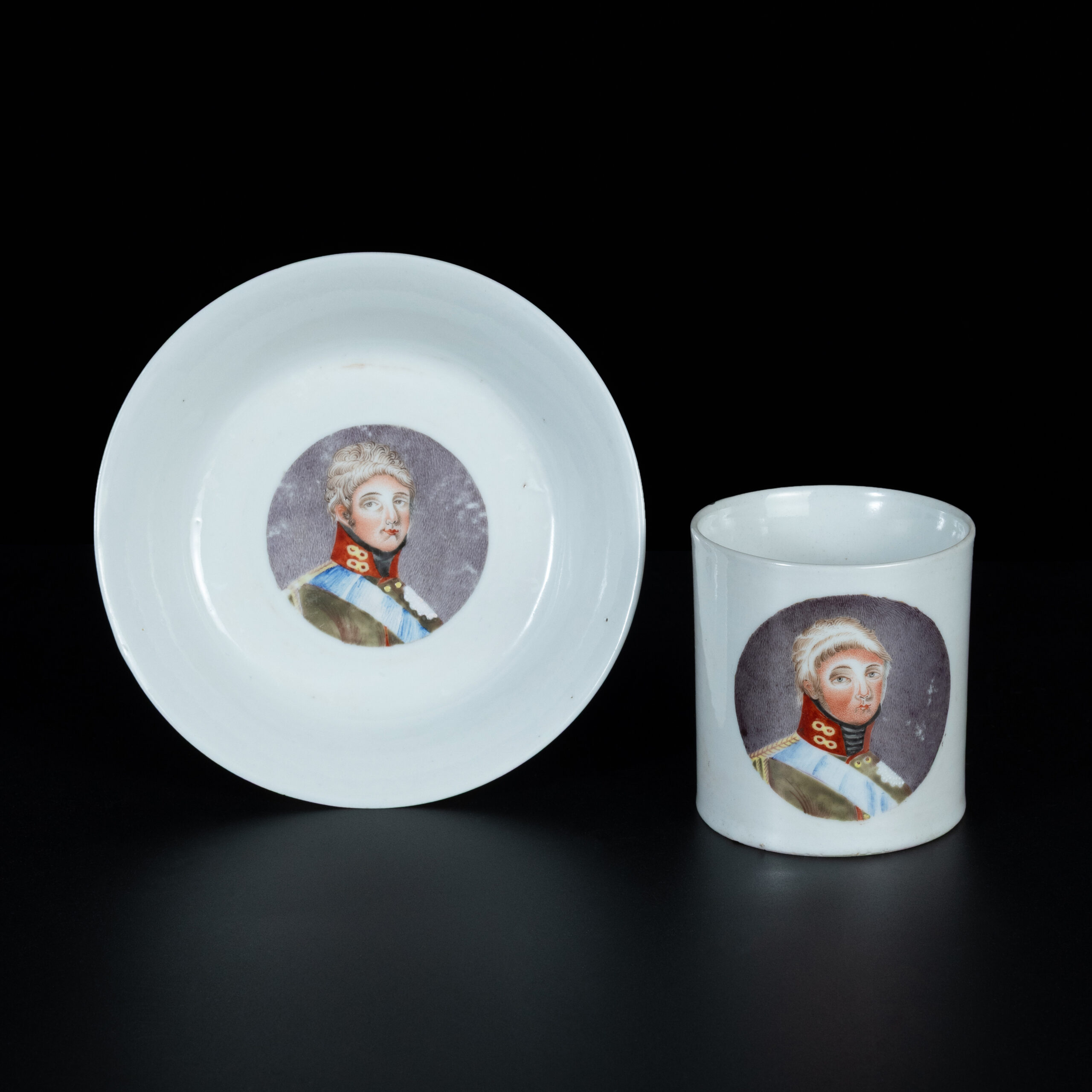
A porcelain cup and its saucer, depicting a portrait of a man painted in a medallion.
ADDITIONAL INFORMATION :
This set is not reproduced in La porcelaine des Compagnies des Indes à décor occidental by F. & N. Hervouët and Y. Bruneau, 1986. However, it does appear in the Hervouët collection sale at Morlaix on 27 March 1989 as lot 94, illustrated on page 20 of the auction catalogue. The catalogue notes: “Rare tasse et soucoupe représentant en médaillon le portrait d’un homme. Époque fin XVIIIe.”
Since no attribution has been made regarding the identity of this man, we venture a tentative identification. On one hand, the porcelain — both in its shape and in its manufacture — clearly corresponds to a production dating from around 1790‑1810.
The man depicted wears dark green velvet garments, together with a blue sash. Suspended from his left shoulder is a medal that seems to take the form of a star. This combination strongly suggests the Order of Saint Andrew.
His hairstyle is quite distinctive, as are the size and style of his beard; the embroidery on his collar is particularly rich. Taking together, all these details lead us to tentatively attribute the portrait to Alexander I (1777–1825), Tsar of Russia, King of Poland and Grand Duke of Finland.
The exact source that inspired this portrait is not clearly identified; nevertheless, several contemporary portraits of Alexander I, dating from the same period as the porcelain, may have served as models. Thse portray him wearing uniform, his characteristic hairstyle, and the Order of Saint Andrew.
Depictions of Emperor Alexander I may well have inspired this medallion painted in China. In particular, one can cite an engraving by Clément du Brusle, held in the Hermitage Museum in Saint Petersburg under the numbers ЭРГ-12094 (third print) and ЭРГ-12061 (second print), portraying the Tsar from this angle.
Another relevant example is an engraving by Henri Buguet after a painting by Marie-Louise-Élisabeth Vigée Le Brun, kept in the Hermitage Museum and dated around 1805, under the number ЭРГ-11923, which depicts the Emperor in this manner.
Miniatures of Alexander I also exist, in a nearly identical profile: notably one painted by Domenico Bossi (Italy, 1765–1853) and dated 1804, wich was sold at Christie’s in London on 26 November 2014 as lot 301 in the sale “Centuries of Style: Silver, European Ceramics, Portrait Miniatures and Gold Boxes.” Domenico Bossi painted several miniatures of Alexander I from various angles. Another interesting example, painted in the same profile, adorns a snuffbox by the St Petersburg master goldsmith Otto Samuel Keibel (active 1797–1809), sold at the Hôtel des Ventes de Genève on 9 December 2013 as lot 176. Another snuffbox, also featuring a miniature of Alexander I—though from a different angle than in our portrait—is held by the Victoria and Albert Museum under the number 442-2008. Several miniaturists portrayed this subject, but it is Bossi who remains the most prominent and who painted it numerous times around 1803–1804.
Although identifying the exact source of the painting reproduced on this medallion is difficult, it was most likely inspired by one of these engravings or miniatures.
We nevertheless struggle to provide an explanation for the presence of Tsar Alexander I on a piece of Chinese export porcelain. Russian commissions are rare, and notable ones are almost exclusively armorial. Three such commissions are known, including a pair of Kangxi period apothecary jars made for Peter the Great, Peter I of Russia (1672–1725); a set of Qianlong dishes made for Elizabeth I of Russia (1709–1762); and a Qianlong service commissioned by Catherine II of Russia (1729–1796). It is therefore unlikely that the piece we are presenting was a commission intended for the Russian market.
Another explanation is possible: a French or European commission intended as a tribute to the Tsar, or to commemorate the peace between Tsar Alexander I and Emperor Napoleon I.
Such a commission could have taken place around 1807, when Alexander I, after his defeat by Napoleon, signed the Treaty of Tilsit and became an ally of France. The Peace of Tilsit led to a mutual exchange of orders: Napoleon awarded Alexander the Legion of Honour, and Alexander conferred on Napoleon the Order of Saint Andrew. Furthermore, in the years following his accession in 1801, Alexander I began—like Catherine II before him—to acquire works by Russian and Western painters, mainly from private collectors. Diplomatic tensions had previously made access to the main art markets, such as France, difficult. But after the Peace of Tilsit in 1807, relations between Alexander I and Napoleon eased, and artistic exchanges became possible, which may provide a meaningful parallel.
As a side note, the painting Adieu de Napoléon et d’Alexandre après la paix de Tilsit, painted in 1810 by Gioacchino Serangeli and kept at the Musée de l’Histoire de France in Versailles under the number MV 1557, depicts Napoleon wearing the blue sash of the Order of Saint Andrew.
PROVENANCE :
– Hervouët Collection
– Dupont & Associates, Morlaix, 27 March 1989, lot 94
– French private collection
SOLD